
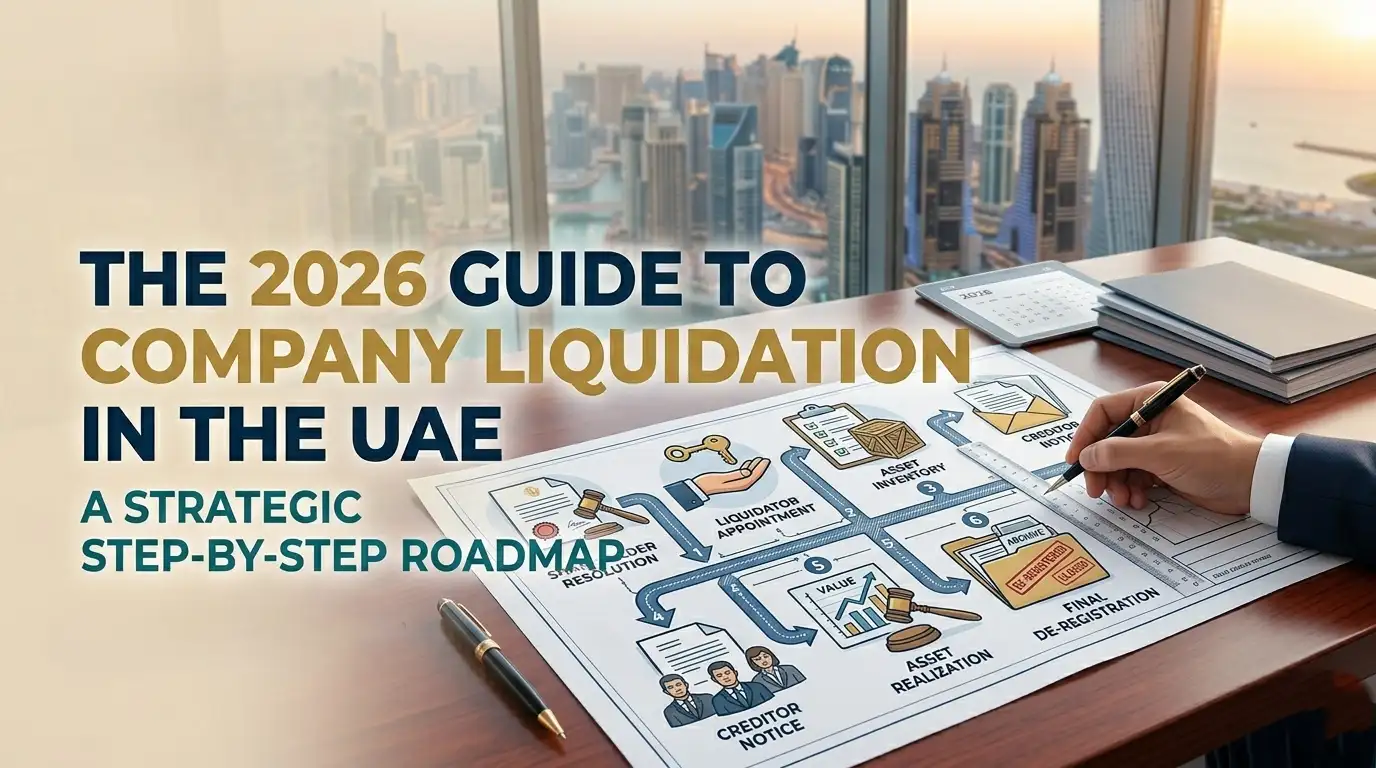
The 2026 Guide to Company Liquidation in the UAE: A Strategic Step-by-Step Roadmap
In the fast-paced UAE market, “exiting” is often as strategic a move as “entering.” Whether you are restructuring a group of companies, pivoting to a new venture, or closing a subsidiary, the process of Company Liquidation in 2026 has become significantly more rigorous.
The days of simply letting a trade license expire are gone. With the full implementation of Corporate Tax and integrated digital reporting, an “informal” closure can lead to massive administrative penalties and blacklisting.
Here is the definitive guide to winding up your UAE entity with total compliance.
Phase 1: The Formal Initiation & Appointment
The process begins with a formal resolution. For Limited Liability Companies (LLCs), the shareholders must pass a resolution to dissolve the company and appoint a Licensed Liquidator.
- The Resolution: This must be notarized by the Notary Public (for mainland companies) or the relevant Free Zone Authority.
- The Liquidator: You cannot liquidate your own firm. You must appoint a registered accounting or legal firm (like The Capital Zone) to act as the official liquidator.
- License Status: Once the resolution is accepted, the company’s license status changes to “Under Liquidation.”
Phase 2: Public Notice and the 45-Day Rule
Transparency is a hallmark of the UAE legal system. To protect creditors and third parties, a public announcement of the liquidation must be made.
- Newspaper Ads: For mainland companies, you are required to publish a notice in two local Arabic newspapers.
- The Waiting Period: Once the notice is published, a 45-day grace period begins. This allows any creditors or individuals with claims against the company to come forward.
- Free Zone Variations: Some Free Zones (like DMCC or ADGM) have digital notification portals that replace or supplement physical newspaper ads.
Phase 3: The “Tax Gating” Step (Critical 2026 Update)
In 2026, the Federal Tax Authority (FTA) is the most significant “gatekeeper” in the liquidation process. You cannot receive a final dissolution certificate until your tax record is spotless.
- VAT Deregistration: You must apply for VAT deregistration within 20 business days of the liquidation resolution. Failure to do so carries a standard AED 10,000 fine.
- Corporate Tax Clearance: For 2026, even if your company was in a loss position, you must file a “Final Tax Return” and settle any outstanding liabilities. The FTA will not issue a “No Objection Certificate” (NOC) until all filings are reconciled.
Phase 4: Employee and Visa Cancellations
Before the final curtain falls, all liabilities toward your workforce must be settled.
- MOHRE Clearance: You must provide proof that all employees have received their full end-of-service benefits (gratuity, leave salary, and final pay).
- GDRFA/ICP Clearance: All visas sponsored by the company (investors, employees, and dependents) must be cancelled.
- Utility & Bank Closures: Clearances from DEWA/SEWA/ADDC and a final bank account closure letter are mandatory.
Phase 5: The Final Liquidation Report
Once the 45-day notice period expires and all clearances are in hand, the liquidator prepares a Final Liquidation Report. This document confirms that all assets have been distributed, all debts have been settled, and no claims remain.
Upon submission of this report to the Department of Economy and Tourism (DET) or your Free Zone Authority, the final Certificate of Dissolution is issued, and the company name is removed from the Commercial Register.
Common 2026 Pitfalls to Avoid
- The “Dormancy” Myth: Thinking that a “dormant” company (one that isn’t trading) doesn’t need to file VAT or Corporate Tax. It does.
- Skipping the Audit: Many Free Zones now require a final liquidation audit report from a registered auditor before they will process the closure.
- Delayed Deregistration: Waiting until the very end to talk to the FTA. Tax deregistration should be one of the first actions you take.
Conclusion: Why Professional Liquidation Matters
Liquidation is a complex legal procedure that involves multiple government touchpoints. Errors in the process don’t just cause delays; they lead to personal liability for directors and shareholders.
At The Capital Zone Liquidators , we handle the entire lifecycle of your business from the first day of formation to the final day of liquidation. Our experts ensure every “i” is dotted and every “t” is crossed, protecting your reputation and your future ventures in the UAE.

All Categories
Recent Posts
Closing a UAE Company with Employees: Final Pay, MOHRE and Visa Cancellation Checklist
Corporate Tax Deregistration During UAE Company Liquidation: What Business Owners Need to Know
What Records Must You Keep After Closing a UAE Company? New FTA Record-Keeping Rules for 2026
Quick support proccess
+971 50 209 9514