
VAT Refunds Before UAE Company Liquidation: The 2026 Credit Deadline
Executive Summary: VAT Refunds Before Company Liquidation
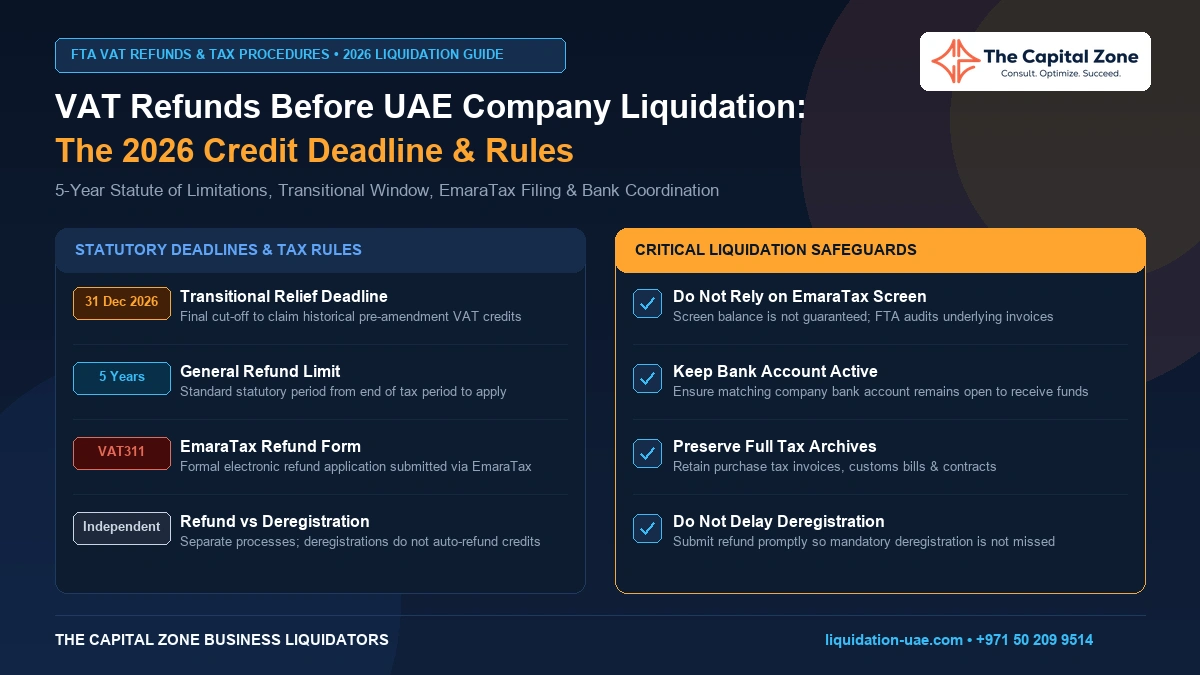
- No Automatic Refunds on Cancellation: Cancelling your trade licence or deregistering for VAT does NOT automatically refund excess input VAT credits. An explicit refund claim (Form VAT311) must be submitted via EmaraTax.
- Critical 2026 Transitional Cut-Off: Under UAE Tax Procedures amendments, companies with historical VAT credits from earlier tax periods face a strict deadline of 31 December 2026 to claim their refunds.
- 5-Year Statute of Limitations: Under the standard rule, tax credit balances must be claimed within 5 years from the end of the relevant tax period, or the right to refund expires.
- Maintain Active Bank Accounts: The company’s corporate bank account must remain open and under the exact licensed entity name until FTA refund disbursements are fully credited.
A UAE company preparing for liquidation should review its VAT credit balance before completing the closure process.
If the business has unused VAT credits or excess tax payments, cancelling the trade licence does not automatically return that money. An eligible refund generally needs to be claimed through the Federal Tax Authority, while the company still maintains the records, banking arrangements and authority needed to support the application.
This is particularly important in 2026 because amendments to the UAE Tax Procedures framework introduced a time limit for claiming certain tax credit balances together with a transitional window for older credits.
For companies with historical VAT balances, the safest approach is to review the position before the end of 2026 rather than leaving the issue until the final stages of liquidation.
Final deadline to file refund claims for pre-amendment historical VAT credits.
Standard statutory period from the tax period end to submit an eligible refund request.
Formal electronic refund application required to return credit balances to the bank.
Distinct procedures; deregistrations do not automatically return accumulated credits.
Why VAT Credits Matter More During Company Closure
An active trading company can often use excess input VAT against future output VAT.
A company being liquidated may no longer have enough future sales to absorb the balance.
That changes the practical position.
Instead of carrying the credit forward, the business may need to determine whether an eligible refund should be requested.
Closure can also make the process more difficult because:
- employees may leave
- accounting software may be cancelled
- access to old invoices can disappear
- company bank accounts may be scheduled for closure
authorised signatories may change; and
a liquidator may take control of company records.
The VAT refund should therefore be treated as its own workstream within the liquidation plan.
What Is the 2026 VAT Credit Deadline?
The General Five-Year Rule
Under the amended UAE Tax Procedures framework, the period for requesting a refund of a credit balance or using it against tax liabilities is generally limited to five years from the end of the relevant tax period.
The important date is linked to the tax period in which the credit arose—not the date on which shareholders decided to liquidate the company.
That means companies should first identify when each part of the VAT credit originated.
Transitional Relief for Older VAT Credits
The 2026 amendments also introduced a one-year transitional period beginning on 1 January 2026 for certain older credit balances.
This is particularly relevant where the normal five-year period had already expired before 1 January 2026 or falls within the transitional period.
For liquidation planning, affected businesses should review and, where appropriate, submit the required claim or use the available credit before 31 December 2026.
This is not a new November deadline. It results from applying the one-year transitional period introduced from 1 January 2026.
Not every VAT credit automatically expires on 31 December 2026. Newer balances and certain other situations require their own deadline assessment.
Which Closing Companies Should Review VAT Credits?
A review is particularly important if the company has:
- a VAT credit shown in EmaraTax
- unused input VAT
- excess tax payments
- an outstanding VAT refund request
- historical unreconciled VAT balances
differences between the ledger and EmaraTax; or
old credits carried forward over several tax periods.
The process can apply to Mainland and Free Zone businesses.
Free Zone status does not automatically create a different VAT refund entitlement.
Where several companies operate under common ownership, confirm which legal taxpayer actually owns the credit before submitting a request.
Six Steps to Protect a VAT Refund During Liquidation
Step 1: Reconcile the VAT Credit
Start by comparing the EmaraTax tax-account history with:
- VAT returns
- voluntary disclosures
- VAT payments
- previous refunds
accounting ledgers; and
adjustments.
Do not rely only on the balance shown on the dashboard.
Prepare a schedule showing:
- the tax period
- source of the credit
- amount
- amount already used
amount previously refunded; and
remaining balance.
This makes it easier to determine which credits may fall within the 2026 transitional period.
Step 2: Confirm the Refund Entitlement and Deadline
Each part of the credit should be tested separately.
Ask:
Is the amount genuinely recoverable?
Has it already been used?
Was it included in an earlier refund?
When did the relevant tax period end?
Does transitional relief apply?
Is another specific rule relevant?
A VAT receivable appearing in the liquidation accounts does not create a new refund right if the applicable claim period has already expired.
That is why the tax review should take place before final accounts are completed.
Step 3: Build a Proper VAT Refund File
A strong refund file should connect the amount claimed to the underlying transactions.
Depending on the company, this can include:
- filed VAT returns
- input VAT reports
- output VAT reports
- supplier invoices
- customer invoices
- credit notes
- customs and import documents
- payment evidence
reconciliations; and
previous FTA correspondence.
The FTA refund process can also require supporting reports, invoices and banking evidence depending on the type of balance being claimed.
The goal is to give the reviewer a clear trail from:
accounting record → VAT return → credit balance → refund request
Step 4: Keep the Bank Account Available
Do not close the company’s bank account too early.
The bank account may still be needed to receive:
- VAT refunds
- customer collections
- supplier refunds
tax adjustments; and
other liquidation receipts.
Before closing the account, coordinate with the liquidator, accountant and tax adviser.
Make sure the refund-receipt arrangement is acceptable and that the beneficiary details registered for the taxpayer remain valid.
A shareholder’s personal bank account should not simply be assumed to be an acceptable replacement for the company’s account.
Step 5: Submit and Monitor the VAT Refund
VAT refund applications are generally submitted through EmaraTax.
Once submitted, keep copies of:
- the application
- supporting documents
- reference number
- acknowledgement
FTA correspondence; and
responses to information requests.
The current FTA service information lists no government service fee for the refund request and provides processing estimates, although additional review or audit can extend the timeframe.
For a company in liquidation, this means the refund should not be assumed to arrive before a particular corporate closure date.
Step 6: Reconcile the Final Refund
The amount appearing as a VAT credit is not necessarily the exact amount that will eventually reach the bank account.
The FTA may, where applicable, set amounts off against outstanding tax liabilities or administrative penalties.
Once the refund is processed, reconcile:
credit claimed → amount approved → amounts offset → cash received
The final figure should then be reflected correctly in the liquidation accounts and closing asset schedule.
VAT Refund and VAT Deregistration Are Separate
One of the most important points during company closure is that a VAT refund and VAT deregistration are not the same process.
A company may need to manage several tax steps at the same time.
An outstanding refund should not be used as a reason to ignore a mandatory VAT deregistration obligation.
The two processes should be coordinated.
For more detail, see our UAE VAT deregistration guide for closing companies.
| Closure Workstream | What to Monitor |
|---|---|
| Historical VAT credit | Transitional deadline and eligibility |
| Other VAT refunds | Applicable claim period |
| VAT deregistration | Applicable FTA deregistration deadline |
| Final VAT return | Filing and payment deadline |
| Corporate Tax | Final filing and deregistration |
| Company liquidation | Registrar and liquidator requirements |
| Bank closure | Final payments and receipts |
Keep VAT Records After the Company Stops Trading
Receiving the VAT refund does not mean all supporting records can immediately be destroyed.
Tax record-retention requirements may continue after trading stops.
The 2026 Tax Procedures changes also provide additional retention considerations where refund claims remain unresolved.
During liquidation, appoint someone responsible for preserving:
- tax returns
- refund submissions
- invoices
- reconciliations
- FTA correspondence
bank evidence; and
final tax decisions.
Keep readable electronic exports before accounting systems, email accounts or document-storage subscriptions are cancelled.
Frequently Asked Questions
Does VAT deregistration automatically refund a credit?
No. An eligible refund generally requires a separate refund request.
Does every UAE company need to claim VAT credits by 31 December 2026?
No. The year-end issue mainly concerns qualifying historical balances affected by the 2026 transitional period. Newer credits require their own deadline assessment.
Can a VAT refund be claimed before company liquidation is completed?
Yes. In many cases, starting the review early is preferable because records, banking access and authorised representatives are still available.
Is the EmaraTax credit balance guaranteed to be refunded?
No. The balance should first be reconciled and supported. Existing liabilities, adjustments or FTA review can affect the final amount.
Can several VAT periods be included in one refund request?
FTA guidance allows eligible balances across multiple periods within the relevant tax type to be included in a consolidated request where applicable.
Can a company delay VAT deregistration until the refund arrives?
Do not assume so. Refund and deregistration deadlines should be managed separately.
Does a Free Zone company receive special VAT refund treatment?
Not simply because it holds a Free Zone licence. VAT entitlement depends on the taxpayer’s actual VAT position and supporting transactions.
What if historical accounting records are incomplete?
Reconstruct and reconcile the relevant records as early as possible. An unsupported accounting estimate is not a substitute for evidence supporting a VAT claim.
Is the VAT refund application free?
The current FTA service lists no government service fee for the refund application. Professional, accounting, banking or liquidation charges are separate.
Can records be deleted after receiving the refund?
No. Continue to follow the applicable tax, audit and company record-retention requirements.
Review VAT Credits Before Finalising the Liquidation
When closing a company, it is easy to focus on licence cancellation, employees, visas, creditors and bank closure.
A recoverable VAT balance can easily be overlooked.
For businesses with older credits, 2026 makes that review particularly important.
The most practical sequence is:
identify the credit → reconcile it → confirm the deadline → prepare evidence → submit the claim → monitor the FTA response → reconcile the outcome → complete the remaining closure
Taking these steps early can help protect a valid company asset before access to records and banking arrangements becomes more difficult.
Professional VAT Refund & Company Liquidation Support in the UAE
The Capital Zone Liquidators helps UAE businesses coordinate company closure, financial records, tax deregistration and liquidation requirements.
Our support can include:
- Mainland company liquidation
- Free Zone company closure
- VAT deregistration coordination
- VAT credit identification
- accounting-record review
- refund documentation support
- final accounts coordination
- Corporate Tax deregistration support
- employee and visa closure
authority clearances; and
final licence cancellation.
If your company has a VAT credit, outstanding refund request or historical tax balance, reviewing it before completing the liquidation can help avoid leaving a recoverable asset unresolved.
Call / WhatsApp: +971 50 209 9514 Landline: +971 4 223 6008 Email: info@liquidation-uae.com
Contact The Capital Zone Liquidators

All Categories
Recent Posts
VAT Refunds Before UAE Company Liquidation: The 2026 Credit Deadline
Closing a UAE Company with Employees: Final Pay, MOHRE and Visa Cancellation Checklist
Corporate Tax Deregistration During UAE Company Liquidation: What Business Owners Need to Know
Quick support proccess
+971 50 209 9514