
Corporate Tax Deregistration During UAE Company Liquidation: What Business Owners Need to Know
Executive Summary: UAE Corporate Tax Deregistration Essentials
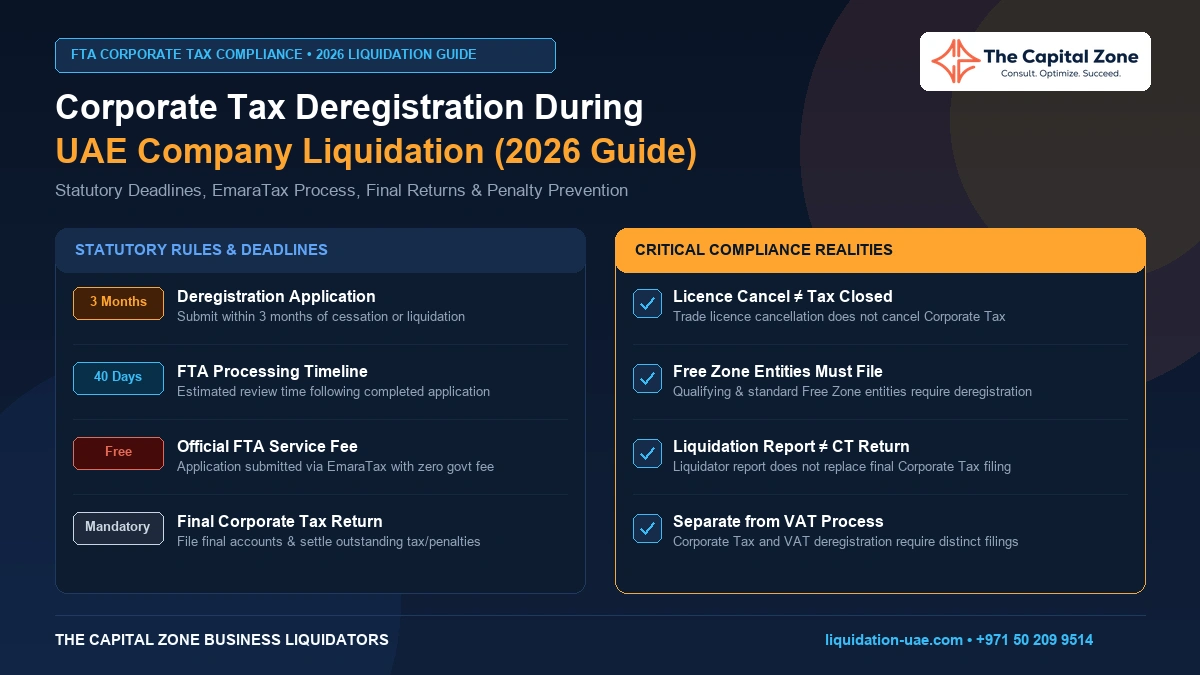
- Separate Legal Obligation: Cancelling your trade licence or concluding formal liquidation does NOT automatically cancel your Federal Tax Authority Corporate Tax registration.
- Strict Three-Month Filing Window: Juridical persons must submit their Corporate Tax deregistration application within three months from the date the entity ceases to exist, dissolves, or liquidates.
- Final Return & Settlement Required: Before the FTA grants final deregistration, all outstanding Corporate Tax returns must be filed, and all assessed tax liabilities and penalties must be settled.
- Free Zone Entities Are Not Exempt: Qualifying Free Zone Persons (QFZPs) enjoying 0% corporate tax rates still have mandatory deregistration obligations upon closure.
Closing a company in the UAE involves more than cancelling the trade licence.
If the company is registered for Corporate Tax, that registration must also be dealt with separately through the Federal Tax Authority. A cancelled licence does not automatically close the company’s Corporate Tax account.
For most juridical persons, the Corporate Tax deregistration application must generally be submitted within three months of the relevant cessation, dissolution, liquidation or other qualifying event.
Before the FTA completes the deregistration, the business must also address its outstanding Corporate Tax obligations, including required returns, tax liabilities and applicable administrative penalties.
For company owners, the important point is simple: Corporate Tax deregistration should be planned as part of the liquidation process, not left until after the company has already closed.
Submit application via EmaraTax within 3 months of the liquidation or cessation date.
Estimated Authority review time once all required documentation has been submitted.
The Federal Tax Authority does not charge any government service fee for deregistration.
VAT deregistration and Corporate Tax deregistration are distinct procedures with separate deadlines.
Corporate Tax Deregistration at a Glance
| Requirement | General Position |
|---|---|
| Deregistration application | Generally within 3 months of the relevant closure event |
| FTA service fee | Free |
| Normal FTA processing time | Around 40 working days after a complete application |
| Final approval | Outstanding returns, tax and penalties must be addressed |
| Key closure documents | Licence cancellation evidence and financial statements |
| VAT deregistration | Separate process |
| Trade licence cancellation | Does not automatically cancel Corporate Tax |
Why the Closure Date Matters
One of the most important parts of Corporate Tax deregistration is identifying the correct closure timeline.
A company may have several different dates during liquidation:
- the date shareholders decide to close
- the date normal trading stops
- the date a liquidator is appointed
- the date remaining assets are sold
- the date employees leave
the date the trade licence is cancelled; and
the date the company is formally dissolved.
These dates are not always the same.
That is why the company should prepare a clear timeline before submitting its deregistration application.
For example, a business may have stopped accepting new customers but still be collecting receivables, paying suppliers or selling equipment. Those remaining transactions may still need to be reflected in the final accounting and Corporate Tax position.
Does an Expired Trade Licence Mean the Company Has Stopped for Corporate Tax?
Not necessarily.
Allowing a trade licence to expire is not the same as completing formal company closure or Corporate Tax deregistration.
A company with an expired licence may still have:
- bank balances
- unpaid customers
- supplier liabilities
- employees
- assets
tax registrations; or
other continuing obligations.
The same applies to a business that has had no recent sales.
Inactivity does not automatically remove the company from the Corporate Tax system.
The actual business and legal position should be reviewed before deciding when the deregistration obligation arose.
Does a Free Zone Company Need Corporate Tax Deregistration?
Yes, where the company is registered for Corporate Tax and is being closed.
A Free Zone company should not assume that a 0% Corporate Tax rate on qualifying income means there is nothing to deregister.
Free Zone tax treatment and company closure are separate issues.
The same principle applies to offshore companies. The word “offshore” by itself does not establish that the entity has no Corporate Tax obligations.
Each legal entity should be reviewed according to its actual registration and tax status.
The Three-Month Deregistration Deadline
FTA Decision No. 6 of 2023 sets the Corporate Tax deregistration timeline.
For a juridical person, the application is generally required within three months of the relevant event, including cessation of business, dissolution or liquidation.
This is different from the normal Corporate Tax return deadline.
The two timelines should not be confused.
Deregistration application
Generally:
Within three months of the relevant closure event.
Corporate Tax return
Generally:
Within nine months after the end of the relevant Tax Period.
A business may therefore need to submit the deregistration application while other final tax work is still being completed.
The application and the final return are connected, but they are not the same filing.
What Documents Are Needed for Corporate Tax Deregistration?
For common business-closure and liquidation cases, the FTA currently identifies important supporting documents including:
licence cancellation documentation; and
financial statements up to and including the licence cancellation date.
Depending on the company’s circumstances, additional information may also be requested.
A well-prepared closure file may include:
- Corporate Tax registration details
- shareholder or board resolution approving closure
- liquidator appointment documents where applicable
- trade licence cancellation documents
- final trial balance
- general ledger
- financial statements
- bank reconciliations
- debtor and creditor schedules
- asset-disposal records
- inventory records
- related-party balances
- Corporate Tax returns
- tax calculations
payment confirmations; and
FTA correspondence.
The information should be consistent.
The legal name, licence number, Tax Registration Number and key dates should match across the supporting documents.
Final Accounts Should Cover the Closing Period Properly
The company’s final accounts should explain what happened during the last stage of the business.
That means recording more than the final sales invoice.
The accounting records may need to include:
- collection of outstanding customer balances
- supplier settlements
- employee final settlements
- bank charges
- professional and liquidation fees
- sale of stock
- sale of equipment
- disposal of assets
- shareholder transactions
related-party balances; and
final cash distributions.
A company should be able to explain how its remaining assets and liabilities were dealt with before closure.
For example, transferring an asset to a shareholder is different from selling it to an unrelated buyer. Writing off a receivable is different from collecting it. Each transaction may have its own accounting and tax treatment.
A Liquidation Report Does Not Replace the Corporate Tax Return
Where a liquidator is appointed, the liquidation report is an important part of the company closure.
But it should not be confused with the company’s Corporate Tax filings.
A liquidation report may explain:
- assets
- liabilities
- creditor settlements
distributions; and
the winding-up process.
The Corporate Tax return serves a different purpose.
Both may therefore be needed as part of an organised closure file.
How to Apply for Corporate Tax Deregistration
The Corporate Tax deregistration application is submitted through EmaraTax.
Businesses should use the correct Taxable Person profile and select the appropriate deregistration reason.
Before submitting, confirm that:
- the deregistration reason is correct
- the relevant dates are supported
- required documents are available
outstanding returns are understood; and
company contact details remain active.
After submitting the application, keep the acknowledgement and reference number.
The status can then be monitored through the Corporate Tax section of the company’s EmaraTax profile.
How Long Does FTA Corporate Tax Deregistration Take?
The FTA’s current service information states an estimated processing period of 40 working days after receiving a completed application.
If additional information is required, the process can take longer.
The FTA may request supporting documents or clarification, and the current service information provides for a further review period after the requested information is resubmitted.
That makes active monitoring important.
Do not submit the application and then close the email account or phone number connected with the company.
Someone should remain responsible for:
- checking EmaraTax
- reviewing emails
answering FTA requests; and
keeping copies of all submissions.
This is particularly important where shareholders leave the UAE during the liquidation.
Final Corporate Tax Obligations Must Still Be Completed
Corporate Tax deregistration is not simply a request to delete the Tax Registration Number.
The applicable Corporate Tax Law requires the company’s outstanding compliance obligations to be addressed before final deregistration.
Depending on the company, this may include:
- outstanding Corporate Tax returns
- the return covering the final period
- Corporate Tax payable
administrative penalties; and
other required information.
A company making a loss may still need to file.
Similarly, a company that closes during its first Tax Period can still have Corporate Tax registration and filing obligations.
No tax payable does not necessarily mean no return is required.
Corporate Tax and VAT Deregistration Are Separate
One of the most common company-closure mistakes is treating all FTA registrations as one process.
They are not.
A company may need to deal separately with:
Corporate Tax deregistration
and
Each process has its own:
- eligibility conditions
- application
- deadlines
final return requirements; and
approval.
Completing VAT deregistration does not cancel Corporate Tax registration.
Likewise, Corporate Tax deregistration does not automatically close VAT.
Businesses should therefore maintain separate status checks for:
- Corporate Tax
- VAT
- trade licence
- commercial register
- employee and immigration records
- bank account
lease; and
other authority registrations.
What Does Corporate Tax Deregistration Cost?
The FTA Corporate Tax deregistration service itself is currently free of charge.
However, the wider company liquidation can involve other costs, including:
- final accounting
- financial statement preparation
- audit where required
- liquidator fees
- licence cancellation
- authority fees
employee and visa cancellation; and
other jurisdiction-specific closure costs.
There is therefore no single total cost that applies to every UAE company.
What Happens if Corporate Tax Deregistration Is Late?
Late Corporate Tax deregistration can result in administrative penalties.
The FTA’s Corporate Tax guidance describes a penalty of:
AED 1,000 for late deregistration, followed by AED 1,000 monthly, up to a maximum of AED 10,000.
Other penalties may apply separately if tax returns or payments are also late.
If a company believes the deadline has already been missed, the best approach is to establish the correct triggering date, complete the outstanding records and submit the application as soon as possible.
Corporate Tax Deregistration Checklist for a Closing UAE Company
Before completing the closure, confirm that you have:
Frequently Asked Questions
Does cancelling a UAE trade licence automatically cancel Corporate Tax registration?
No. Corporate Tax deregistration is a separate FTA process. Licence cancellation can support the application, but the tax registration must be closed separately.
What is the Corporate Tax deregistration deadline in the UAE?
For a juridical person, the application is generally due within three months of the relevant cessation, dissolution, liquidation or other qualifying event.
Is the three-month deadline the same as the Corporate Tax return deadline?
No. The deregistration application generally has a three-month deadline, while a Corporate Tax return is generally due within nine months after the relevant Tax Period ends.
Can a company with no sales simply deregister?
Not automatically. The company’s actual activities, assets, liabilities and closure status should be reviewed first.
Does a loss-making company still need to file a final Corporate Tax return?
Where a return is required, making a loss or having no Corporate Tax payable does not by itself remove the filing requirement.
What documents does the FTA require for company closure?
For common liquidation and closure cases, the FTA service information lists licence cancellation documentation and financial statements through the relevant cancellation date. Additional documents may be requested.
How long does Corporate Tax deregistration take?
The FTA currently gives an estimated processing time of 40 working days for a completed application, although requests for additional information can extend the process.
Is Corporate Tax deregistration free?
The FTA deregistration service is currently free. Other accounting, audit, liquidator and company-closure costs can still apply.
Does Corporate Tax deregistration also cancel VAT?
No. VAT deregistration must be handled separately.
Plan Corporate Tax Deregistration as Part of the Liquidation
Corporate Tax should not be left until the final day of company closure.
A better approach is to plan the tax exit alongside:
- final accounting
- liquidation documentation
- asset disposal
- employee closure
- VAT deregistration
licence cancellation; and
authority clearances.
The key is to establish the correct timeline early.
Once shareholders have decided to close the company, management should identify what activity remains, when the company will actually cease operating and what documents will be needed for the final tax position.
That can make the deregistration process considerably easier than trying to rebuild the company’s records after the licence, office and bank accounts have already been closed.
Professional Company Liquidation & Tax Deregistration in the UAE
The Capital Zone Liquidators supports Mainland, Free Zone and other UAE businesses through the company-closure process.
Our support can include coordination of:
- company liquidation
- liquidator requirements where applicable
- final accounting records
- licence cancellation
- VAT deregistration
- Corporate Tax deregistration
- employee and visa cancellation
- asset and liability documentation
authority clearances; and
final company deregistration.
Where specialist tax preparation is required, Corporate Tax and accounting support can also be coordinated as part of the wider closure process.
Planning to close a UAE company? Speak with The Capital Zone Liquidators about coordinating the liquidation and tax deregistration requirements from the beginning.
Call / WhatsApp: +971 50 209 9514 Email: info@liquidation-uae.com

All Categories
Recent Posts
Corporate Tax Deregistration During UAE Company Liquidation: What Business Owners Need to Know
What Records Must You Keep After Closing a UAE Company? New FTA Record-Keeping Rules for 2026
Metal Scrap VAT During UAE Company Liquidation in 2026: What Businesses Need to Know
Quick support proccess
+971 50 209 9514