
Metal Scrap VAT During UAE Company Liquidation in 2026: What Businesses Need to Know
Executive Summary: Metal Scrap VAT & Reverse Charge During Liquidation
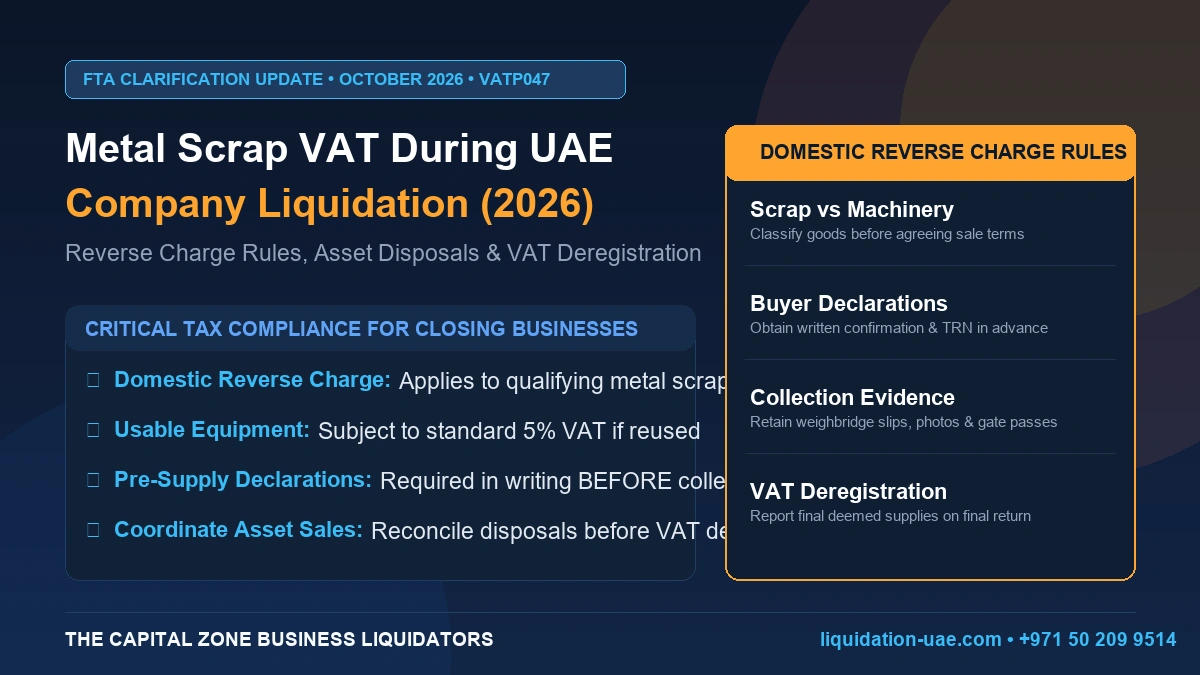
- Domestic Reverse Charge Framework: Under Cabinet Decision No. 139 of 2024 and FTA Public Clarification VATP047, sales of qualifying metal scrap, metal waste and recycled metal are subject to the domestic reverse charge rather than standard 5% VAT collection by the seller.
- Classification Is Critical: Functional machinery or equipment sold for continued operational use is NOT metal scrap and remains subject to standard 5% VAT.
- Mandatory Pre-Supply Documentation: The selling company must obtain written buyer declarations of intended use and verify VAT registration before goods leave the premises. Late declarations void reverse charge protection.
- Coordinate Disposals with VAT Deregistration: Asset clearances, scrap proceeds, and deemed supplies on retained goods must be reconciled in final accounts and reported on the final VAT return prior to completing company liquidation.
When a UAE company enters liquidation, one of the most practical questions is what happens to the assets that remain behind on the premises.
Factories may still hold machinery, metal components and production waste. Workshops may have damaged equipment or scrap iron. Warehouses frequently contain racking, obsolete stock and metal fixtures. For VAT-registered businesses, these disposals are not simply an operational clean-up exercise—they carry immediate tax consequences.
The Federal Tax Authority published a new public clarification concerning the application of the domestic reverse charge on metal scrap. For companies already undergoing company liquidation in the UAE, the timing is particularly relevant: a qualifying metal-scrap sale may be subject to the reverse charge mechanism rather than ordinary VAT collection by the seller, but only where specific statutory conditions and documentation requirements are satisfied before the goods are supplied.
What Has the FTA Clarified in October 2026?
The FTA listed its new metal-scrap public clarification on 2 October 2026. Importantly, this does not mean the reverse charge regime itself only began in October. The underlying framework comes from Cabinet Decision No. 139 of 2024 (amending Cabinet Decision No. 52 of 2017) and Ministerial Decision No. 262 of 2024, which set out the reverse charge rules for metal scrap and related goods.
Why the Clarification Matters for Liquidating Businesses
During company winding-up, physical asset sales often happen under extreme time pressure:
- Expiring Leases & Warehouse Handover: Facilities must be vacated rapidly to avoid lease penalties.
- Simultaneous Visa & Labour Closures: Key technical and warehouse personnel may be departing.
- Creditor Settlements & Asset Realisation: Cash proceeds must be distributed to settle liquidation obligations.
- Parallel VAT Deregistration: The VAT deregistration process requires accurate final accounting.
Warning: If the company treats every metal item as “scrap” and addresses VAT only after collection, it may discover too late that it failed to obtain mandatory pre-supply declarations.
Not Every Metal Item Sold During Liquidation Is Automatically “Metal Scrap”
The first critical step is proper asset classification. A closing factory may sell an old machine to another manufacturer for continued use, while simultaneously selling damaged steel components to a scrap recycling yard. Those transactions should not receive the same VAT treatment simply because both items contain metal.
Distinguishing Scrap from Functional Business Assets
- Usable Machinery & Vehicles: Equipment sold for continued operational use constitutes a standard business asset disposal, subject to 5% standard VAT.
- Damaged Equipment for Material Recovery: Machines incapable of functional repair, sold solely for dismantling and smelting, may qualify as scrap subject to reverse charge.
- Metal Production Waste & Offcuts: Metal shavings, cuttings, and manufacturing residues destined for melting qualify under the metal scrap rules.
- Structural Fixtures & Racking: Dismantled mezzanine floors, warehouse racks, and steel structures require assessment based on whether they are sold as reusable equipment or scrap raw material.
- Non-Metal Clearance Items: Timber pallets, plastics, packaging, and furniture do not fall under metal scrap rules and must be invoiced separately.
When Can the Metal Scrap Reverse Charge Apply?
Under the UAE VAT framework, the domestic reverse charge mechanism can apply to qualifying metal scrap and recycled metal supplies where three cumulative statutory conditions are satisfied:
The 3 Mandatory Conditions for Reverse Charge Eligibility
- Condition 1 — Nature of Goods: The goods must qualify as metal scrap, metal waste, or recycled metal under Cabinet Decision No. 139 of 2024 and Ministerial Decision No. 262 of 2024.
- Condition 2 — Buyer Status: The buyer must be registered for VAT with the Federal Tax Authority (FTA) at the time of supply.
- Condition 3 — Intended Use Declaration: The buyer must provide a written declaration confirming that the goods will be used for manufacturing, processing, or melting into new metal goods, or for resale in the same form to another VAT registrant.
Why Pre-Supply Documentation Matters During Liquidation
Documentation Must Be Collected BEFORE Goods Leave the Premises
Under the reverse charge mechanism, obtaining written buyer declarations and VAT verification prior to the date of supply is mandatory. If the company allows a scrap buyer to collect metal without pre-supply documentation:
- The transaction reverts to a standard 5% taxable supply.
- The seller remains legally liable to the FTA for uncollected VAT plus late payment penalties.
- Collecting declarations weeks later after staff have left or bank accounts are closed is rarely accepted by the FTA.
A Better Way to Manage Scrap and Asset Sales During Company Liquidation
A structured disposal process prevents tax exposure and ensures the company’s final liquidation accounts reconcile perfectly:
Prepare a Detailed Disposal Register
Create an itemised inventory of machinery, equipment, metal waste, and spare parts. Record serial numbers, asset tag IDs, operational condition, and photographic evidence before inviting scrap buyers.
Confirm Ownership & Right of Sale
Verify that leased equipment, third-party tooling, and customer-owned inventory are excluded. Obtain formal clearance from banks, financing houses, and landlords before removing fixed installations.
Verify VAT Position & Obtain Declarations in Advance
Confirm the buyer’s active VAT TRN on EmaraTax and obtain their signed statutory reverse charge declaration. Issue a compliant Tax Invoice clearly referencing reverse charge under Cabinet Decision No. 139 of 2024.
Retain Complete Collection & Removal Evidence
Secure signed handover delivery notes, certified weighbridge slips (gross and tare weights), transport vehicle registrations, driver IDs, and facility exit security gate passes for the audit file.
Reconcile Proceeds in Liquidation Ledgers
Deposit all sale proceeds directly into the official company bank account. Record asset disposal journal entries, write off residual book values, and reconcile bank ledgers before closing banking facilities.
Free Zone Companies, Designated Zones & Cross-Border Exports
Licensing geography and goods movement dictate the exact VAT treatment during company closure:
Checking the VAT Geography of Asset Sales
- Standard Free Zones: Entities in non-Designated Free Zones (e.g. DMCC, IFZA, Meydan) operate under standard UAE VAT territory rules. Scrap sales to UAE buyers follow standard reverse charge rules.
- Designated Zones: Scrap sales physically located inside a VAT Designated Zone (e.g. JAFZA, DAFZA, KIZAD) require careful review of whether goods remain inside the Designated Zone or are moved to the UAE Mainland.
- Customs Declarations: Moving scrap from a Designated Zone to Mainland requires customs import documentation and clearance before collection.
Scrap Sold to Overseas Buyers
- 0% Direct Exports: Qualifying direct exports outside the UAE can be zero-rated only where official customs exit declarations and commercial transport proofs (bill of lading/airway bill) are retained.
- Local Collection by Foreign Buyers: If an overseas buyer collects scrap locally within the UAE without formal export documentation, the domestic reverse charge does not apply—standard 5% VAT must be charged.
Metal Scrap Disposal Checklist for a Closing UAE Company
Retain the following records in the permanent company closure file to satisfy liquidator review and FTA tax audit standards:
| Review Area | Evidence to Retain for Audit Trail |
|---|---|
| Classification of Goods | Itemised inventory, detailed photographs and condition assessment records |
| Asset Ownership | Fixed asset register, purchase invoices, lease releases or finance clearance certificates |
| Buyer Details | Buyer legal entity name, trade licence copy and complete transaction file |
| Buyer VAT Status | Active VAT registration certificate & FTA TRN verification records |
| Reverse Charge Eligibility | Written pre-supply declaration confirming intended use for manufacturing/melting |
| Commercial Sale Terms | Formal quotation, sale agreement, agreed unit rate and invoice explicitly noting reverse charge |
| Collection & Removal | Signed handover delivery note, certified weighbridge weight slips and transport evidence |
| Payment Records | Tax invoice, bank statement receipt, payment voucher and accounting ledger reconciliation |
| Accounting Entries | Disposal journal entry, write-off documentation and fixed asset ledger reconciliation |
| Tax Closure & Return | Box 3/Box 1b VAT return reporting and final VAT deregistration file support |
7 Common Mistakes During Factory and Warehouse Liquidation
Avoid These Critical Liquidation Errors
- 1. Treating Every Old Asset as Scrap: A used machine sold for functional reuse is subject to 5% VAT. Classify before agreeing commercial terms.
- 2. Relying on the Buyer’s Verbal Assurance: The seller remains strictly liable for unpaid VAT if the buyer fails to supply written declarations.
- 3. Collecting Declarations After Collection: Post-supply paperwork does not cure missing pre-supply statutory requirements.
- 4. Issuing One Lump-Sum Generic Invoice: Bulk clearing a factory with mixed machinery, scrap, and wood creates severe audit risks. Itemise lots clearly.
- 5. Closing Bank Accounts Prematurely: Disposal proceeds and final VAT settlements require an active bank account up to the effective deregistration date.
- 6. Assuming Free Zone Entities Are VAT-Exempt: Free Zone companies are fully subject to UAE VAT rules and reverse charge conditions.
- 7. Rushing VAT Deregistration Before Disposals: Retaining assets after the effective deregistration date triggers deemed supply VAT liabilities on the final return.
How The Capital Zone Liquidators Can Help
Closing a manufacturing facility, workshop, or commercial warehouse involves significantly more than cancelling a trade licence.
The Capital Zone Business Liquidators coordinates the entire corporate, accounting, and tax closure roadmap across UAE Mainland and Free Zone jurisdictions:
End-to-End Closure & Compliance Services
- Asset Disposal & Tax Review: Classifying equipment, scrap, and inventory under FTA reverse charge rules.
- Liquidator Appointments & Reports: Preparing official shareholder resolutions, liquidator acceptance letters, and final statements of account.
- FTA VAT & Corporate Tax Deregistration: Handling EmaraTax submissions, final returns, penalty waivers, and clearance certificates.
- Licence Cancellation: Securing final deregistration certificates from DED, Free Zone authorities, and commercial registries.
- Immigration & Establishment Closure: Cancelling partner/employee visas and closing Ministry of Human Resources and Emiratisation (MOHRE) files.
Frequently Asked Questions About Metal Scrap VAT During Liquidation
Does company liquidation automatically make a metal scrap sale subject to reverse charge?
No. Liquidation does not determine the VAT treatment. The goods, buyer, VAT registration status, intended use and pre-supply documentation must all satisfy the statutory conditions in Cabinet Decision No. 139 of 2024 and FTA Clarification VATP047.
Is every old metal machine considered scrap?
No. A machine being sold for continued use is not qualifying metal scrap. It remains an ordinary supply of a used business asset subject to standard 5% VAT unless another specific provision applies.
Can a closing company sell its entire warehouse as one scrap lot?
Commercially, multiple items can be sold together, but the company must identify whether the lot includes non-metal items, usable machinery, or third-party property so the correct VAT and accounting treatments are applied.
What documents are important for a reverse charge scrap transaction?
The file should include the buyer’s written declaration of intended use, VAT registration verification, itemised disposal schedule, weighbridge weight records, signed delivery note, tax invoice noting reverse charge, and payment reconciliation.
What happens if the buyer provides the documents after collection?
Documentation completed after supply does not automatically cure missing pre-supply requirements. If statutory conditions were not satisfied prior to supply, standard VAT rules may apply.
Is reverse charge the same as zero-rated VAT?
No. Under reverse charge, responsibility for accounting for VAT shifts to the registered buyer on their VAT return. It is not an exemption or zero-rating of the underlying transaction.
Should scrap sale proceeds still appear in the liquidation accounts?
Yes. Even where the VAT reporting mechanism shifts, the company still needs to record the disposal, account for proceeds in bank/cash ledgers, and explain asset movements in the final liquidation accounts.
Does a Free Zone company automatically qualify for special scrap VAT treatment?
No. Free Zone licensing status and VAT treatment must be assessed separately. The location of the goods, Designated Zone boundaries, and buyer status determine the actual tax treatment.
Should VAT deregistration be completed before the company sells remaining assets?
Planned asset sales should be completed and accounted for before final VAT deregistration. Disposals after deregistration can create deemed-supply reporting issues on the final VAT return.
Does VAT deregistration also cancel Corporate Tax registration?
No. VAT and Corporate Tax deregistration are separate FTA processes and must be tracked and applied for independently.
Need Support With Factory, Warehouse or Asset Disposal During Liquidation?
Closing a UAE manufacturing plant, workshop or commercial facility involves complex asset disposals, VAT reverse charge compliance, FTA deregistration, and legal company winding up. The Capital Zone Business Liquidators coordinates the entire corporate, accounting, and tax closure roadmap.

All Categories
Recent Posts
Corporate Tax Deregistration During UAE Company Liquidation: What Business Owners Need to Know
What Records Must You Keep After Closing a UAE Company? New FTA Record-Keeping Rules for 2026
Metal Scrap VAT During UAE Company Liquidation in 2026: What Businesses Need to Know
Quick support proccess
+971 50 209 9514