
What Records Must You Keep After Closing a UAE Company? New FTA Record-Keeping Rules for 2026
Executive Summary: Record Retention After UAE Company Liquidation
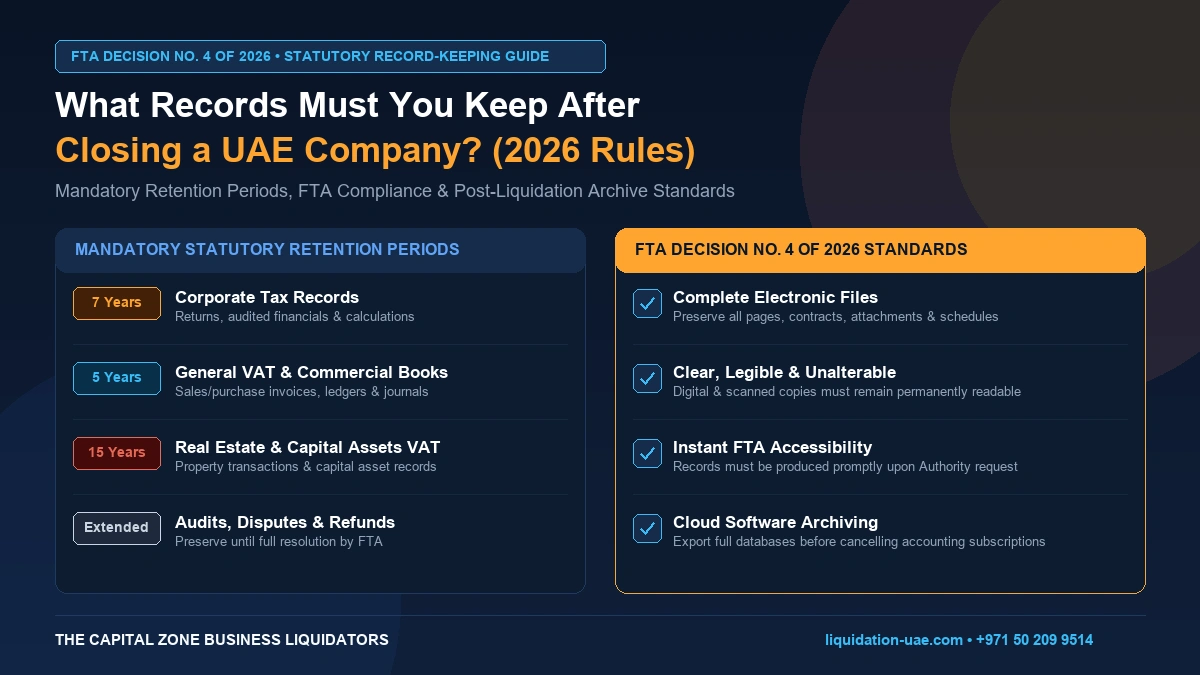
- Cancellation Does Not Eliminate Retention: Closing a trade licence, completing liquidation, or cancelling tax registrations does NOT terminate statutory record-keeping obligations.
- Varied Statutory Timelines: Different records carry different retention periods—7 years for Corporate Tax, 5 years for Commercial Companies Law & general VAT, and 15 years for real-estate VAT records.
- FTA Decision No. 4 of 2026 Standards: Electronic files, scanned PDFs, and cloud archives must remain complete (no missing pages/schedules), legible, unalterable, and instantly accessible to the Federal Tax Authority.
- Preserve Before Cancelling Software: Never delete accounting software subscriptions (Xero, QuickBooks, Zoho) or email accounts without generating full immutable ledger backups, transaction attachments, and tax files.
Closing a UAE company does not mean its records can be deleted, discarded or forgotten as soon as the trade licence is cancelled.
A company may have stopped trading, completed liquidation, cancelled employee visas and closed its office, but accounting, tax and commercial records can still need to be available for years afterward.
This became particularly important in 2026 following new developments in the UAE’s tax record-keeping framework.
The Federal Tax Authority published FTA Decision No. 4 of 2026 on the Rules and Requirements for Maintaining the Information Contained in Accounting Records and Commercial Books in August 2026. The decision was issued on 2 June 2026 and introduces more specific standards for the way accounting records and commercial books are preserved, particularly when businesses rely on electronic copies, scanned documents or third-party record storage.
Separately, amendments to the Tax Procedures Executive Regulation effective from 1 April 2026 introduced an additional record-retention period for certain unresolved tax-refund claims.
For business owners preparing for company liquidation in the UAE, the practical message is simple:
Do not treat document disposal as part of office clearance. Record retention should be planned as a formal part of the liquidation process.
Quick Answer: How Long Should Records Be Kept After a UAE Company Closes?
There is no single retention period that applies to every document.
Different laws can apply to different records.
The FTA specifically states that Corporate Tax records and documents should be retained for at least seven years following the end of the relevant Tax Period.
VAT legislation separately requires records relating to real property to be retained for 15 years after the end of the relevant tax period.
Therefore, a liquidating company should not simply apply a five-year deletion rule to every document.
Retain all Corporate Tax returns, working papers, audited accounts, and deregistration evidence for at least 7 years.
Maintain general VAT invoices, ledger books, daybooks, and Commercial Companies Law records for at least 5 years.
All capital assets and VAT documents relating to real property require mandatory retention for 15 full years.
Under 2026 Tax Procedures amendments, records linked to active disputes or refund claims must be preserved beyond standard limits.
| Type of Record | General Retention Position |
|---|---|
| Corporate Tax records | At least 7 years after the end of the relevant Tax Period |
| General tax records under the Tax Procedures framework | Generally 5 years after the relevant Tax Period |
| VAT records | Generally 5 years |
| VAT records relating to real estate | 15 years |
| Company accounting records under the Commercial Companies Law | At least 5 years after the end of the relevant financial year |
| Commercial correspondence, invoices and supporting commercial books | Generally at least 5 years, subject to the applicable law |
| Records connected with an ongoing tax dispute, audit, refund or other specified event | Longer periods can apply |
What Changed Under FTA Decision No. 4 of 2026?
FTA Decision No. 4 of 2026 does not replace all existing tax-retention periods.
Instead, it strengthens and clarifies how information contained in accounting records and commercial books must be maintained.
This is especially relevant because modern businesses often no longer maintain complete paper archives. Records may be stored in:
- accounting software
- cloud platforms
- scanned PDF files
- document-management systems
- outsourced bookkeeping systems
external servers; or
electronic archives.
Under the new framework, keeping a digital file is not enough if that file is incomplete, unreadable or inaccessible.
Electronic copies and photocopies should accurately preserve the original record and remain available when required.
Electronic Records Must Be Complete
A common record-keeping mistake is scanning only the page that appears important.
For example, a five-page contract may be stored as only the signature page.
An invoice pack might exclude attachments.
A bank document might be saved without supporting pages.
Under the 2026 requirements, retained copies should preserve the complete information contained in the original document, including the relevant pages in their proper sequence.
Businesses entering liquidation should therefore review old document folders before destroying originals.
Records Must Remain Clear and Legible
A stored document has little value if nobody can read it later.
Scanned and copied records should remain:
- clear
- complete
- properly oriented
- readable
retrievable; and
usable throughout the required retention period.
This matters when records are stored for several years.
Low-quality scans, corrupted PDFs or files saved in obsolete formats can create problems long after the physical office has closed.
The FTA Must Be Able to Access the Records
Accessibility is one of the most important aspects of the new rules.
Records should not be stored in a system that becomes inaccessible once:
- the company’s accounting subscription expires
- an employee leaves
- the bookkeeping company changes
the company email account is cancelled; or
the old server is switched off.
Where electronic records are protected by encryption, access controls or other security measures, the company needs to ensure that the information can still be retrieved if required by the FTA.
This is why closing a company should include a digital-record handover, not simply cancellation of software accounts.
Outsourcing Your Accounting Does Not Mean You Can Forget the Records
Many UAE companies outsource bookkeeping, accounting, VAT filing or Corporate Tax preparation.
That can make record storage more complex during liquidation.
A business might assume:
“Our accountant has everything, so we do not need to keep a copy.”
That is a risky approach.
FTA Decision No. 4 makes it particularly important for businesses to retain control over and access to their records even where accounting or document storage is handled by another party.
Before ending an accounting-service contract during liquidation, the company should obtain a complete archive containing the financial and tax records it may need later.
Which Accounting Records Should Be Kept After Company Liquidation?
The Tax Procedures framework identifies a broad range of accounting records and commercial books.
These include records relating to payments, receipts, purchases, sales, revenues and expenses as well as supporting documentation. The Executive Regulation specifically refers to items such as balance sheets, profit-and-loss accounts, payroll, fixed-asset records and inventory records.
For a closing company, the archive should normally include the following categories.
Financial Statements
Keep the company’s:
- balance sheets
- profit and loss statements
- trial balances
- general ledgers
- cash-flow information where prepared
closing financial statements; and
final liquidation accounts.
The final accounting period is particularly important because it explains the company’s financial position immediately before closure.
Sales and Customer Records
Retain documents supporting company revenue, including:
- sales invoices
- customer contracts
- credit notes
- receipts
- customer statements
- outstanding receivable schedules
bad-debt records; and
evidence of final collections.
These documents can be important if a tax authority later asks how reported revenue was calculated.
Supplier and Expense Records
Keep:
- purchase invoices
- supplier statements
- supplier contracts
- expense receipts
- payment records
- purchase orders
credit notes; and
documents supporting deductions claimed for Corporate Tax.
An expense recorded in the ledger should ideally be traceable back to the underlying transaction.
Keep Bank Records Even After the Bank Account Is Closed
Once liquidation is complete, shareholders may be tempted to retain only the final bank statement.
That is rarely sufficient.
The liquidation archive should generally contain:
- bank statements
- completed bank reconciliations
- loan statements
- finance agreements
- payment confirmations
- evidence of shareholder funding
- related-party transfers
final settlement records; and
documentation confirming closure of the account.
Bank information can be critical if questions later arise about:
- unpaid liabilities
- shareholder balances
- asset-sale proceeds
tax payments; or
unusual transactions during liquidation.
Download the records before closing online banking access.
Keep Asset and Inventory Disposal Records
Asset disposal is an important part of many UAE liquidations.
A company may sell:
- vehicles
- machinery
- office equipment
- furniture
- computers
- inventory
warehouse stock; or
scrap material.
The records should explain:
- what the company owned
- what was sold
- who purchased it
- sale price
- VAT treatment
- date of disposal
payment received; and
accounting treatment.
The FTA has previously emphasised that Corporate Tax records should include information relating to assets, including purchases and disposals.
A disposal register can be especially useful for factories, warehouses, workshops and trading companies.
Corporate Tax Records Must Generally Be Kept for Seven Years
For companies subject to UAE Corporate Tax, the record-retention period deserves particular attention.
The FTA states that relevant Corporate Tax records and documents should be retained for at least seven years following the end of the Tax Period to which they relate.
This can include records supporting:
- taxable income
- business revenue
- deductible expenditure
- non-deductible expenses
- exempt income
- tax losses
- related-party transactions
- transfer-pricing positions
- assets and liabilities
- tax adjustments
Corporate Tax returns; and
calculations supporting positions taken in those returns.
Corporate Tax Record Retention Calculation
Suppose a company liquidates during 2026 and its final Corporate Tax period ends in 2026.
The seven-year retention period is measured from the end of that relevant Tax Period—not simply from the date the trade licence was cancelled.
This is why records can remain necessary long after the legal company has ceased active operations.
Keep the Final Corporate Tax Deregistration File
The FTA currently requires important supporting documents for Corporate Tax deregistration in liquidation or closure cases.
For common liquidation and business-closure scenarios, the FTA identifies documents including:
licence cancellation documentation; and
financial statements up to and including the licence cancellation or cessation date.
A closing company’s permanent tax archive should therefore include:
- Corporate Tax registration certificate
- final Corporate Tax return
- supporting calculations
- financial statements
- tax-payment confirmations
- deregistration application
correspondence with the FTA; and
final deregistration confirmation.
VAT Records Should Not Be Destroyed After VAT Deregistration
VAT deregistration closes the registration.
It does not erase the historical transactions reported while the business was VAT registered.
General VAT records should normally be retained for at least five years, subject to the Tax Procedures framework and any longer rule that applies.
Important VAT records include:
- VAT returns
- tax invoices issued
- tax invoices received
- tax credit notes
- import records
- export records
- reverse-charge records
- input VAT calculations
- output VAT calculations
- VAT reconciliations
- adjustments and corrections
VAT deregistration documents; and
the final VAT Deregistration Certificate.
The VAT Law itself requires taxable persons to maintain records of supplies, imports, invoices, credit notes and other relevant transactions.
Real-Estate VAT Records Can Require 15 Years
This is an important exception.
Under the UAE VAT Executive Regulation, records related to real property that are required to be maintained must be retained for 15 years following the end of the tax period to which they relate.
This can be particularly relevant where a liquidating company:
- owned property
- developed real estate
- leased commercial property
made property-related taxable supplies; or
had material VAT adjustments connected with real estate.
For such companies, a general five- or seven-year archive policy may not be sufficient.
The 2026 Tax Procedures Amendment Can Extend Record Retention
Another important change took effect on 1 April 2026.
The Ministry of Finance confirmed amendments to the Tax Procedures Executive Regulation that extend the retention period by an additional two years for tax periods connected with a refund application submitted before the limitation period expired where the FTA has not yet issued a decision.
This matters during liquidation because a business may be closing while it still has:
- a VAT refund application
- another tax-credit balance
an unresolved FTA review; or
an outstanding tax matter.
The company should not destroy the supporting records simply because its licence has already been cancelled.
Tax Audits and Disputes Can Require Records to Be Kept Longer
Standard retention periods are not always the end of the story.
The Tax Procedures Executive Regulation provides additional retention periods in circumstances including:
- an unresolved dispute with the FTA
- an ongoing tax audit
notification that the FTA intends to conduct a tax audit; and
certain voluntary disclosures submitted close to the end of the normal retention period.
The 2026 amendments also strengthened provisions relating to retention of documents or assets for tax-audit and examination purposes.
Therefore:
Never schedule automatic deletion of company tax records solely according to the ordinary retention period if an audit, refund, dispute or correction remains open.
Commercial Company Records Also Have Retention Requirements
Tax legislation is not the only reason to preserve records.
Federal Commercial Companies legislation requires companies within its scope to maintain accounting records capable of showing their financial position and generally requires those accounting records to be kept for at least five years after the end of the company’s financial year.
The UAE Commercial Transactions Law also contains record-retention provisions for commercial correspondence, invoices, books and supporting documentation, generally using a minimum five-year period for the relevant records within its scope.
A closing business must therefore consider tax law and commercial law together.
Liquidation Records Should Be Preserved Separately
Tax documents are only part of the closure file.
A company should also preserve the records proving how the liquidation itself was conducted.
Depending on the legal form and jurisdiction, these may include:
- shareholder or board resolution approving liquidation
- liquidator appointment
- liquidator acceptance
- notices to creditors
- newspaper publications where applicable
- creditor claims
- debtor schedules
- asset and liability statement
- final liquidation report
- liquidator’s accounts
- clearance certificates
- employee cancellation records
- lease termination
- authority clearances
licence cancellation certificate; and
commercial deregistration evidence.
Under the federal Commercial Companies Law, a liquidator is required to prepare a detailed list of the company’s assets and liabilities and maintain records documenting transactions connected with the liquidation.
These documents form the history of how the company was wound up.
Keep Employee and Payroll Records
A closing business should also retain sufficient evidence of how employees were dealt with.
Useful records include:
- employment contracts
- payroll records
- salary statements
- leave calculations
- gratuity or end-of-service calculations where applicable
- final settlements
- work-permit cancellation evidence
visa cancellation documents; and
evidence of final payments.
Payroll is also specifically recognised as part of the accounting records under the Tax Procedures framework.
These records can help if questions arise after employees have left and the company office has closed.
Keep Shareholder, UBO and Corporate Records
The permanent closure archive should also contain the company’s corporate history.
This can include:
- certificate of incorporation
- memorandum and articles
- trade licences
- licence amendments
- shareholder register
- share-transfer documents
- UBO records
- director records
- authorised-signatory records
- board and shareholder resolutions
branch records; and
final cancellation certificates.
These records help establish who owned and controlled the company at different stages of its life.
They can also be important where historic bank, tax or legal questions arise.
Do Not Delete Accounting Software Immediately After Closure
One of the easiest mistakes to make is cancelling the company’s accounting software immediately after the final invoice is issued.
Before terminating access, export:
- general ledger
- trial balances
- financial statements
- customer ledger
- supplier ledger
- VAT reports
- Corporate Tax workpapers
- fixed-asset register
- inventory records
- journal entries
- invoices
- credit notes
attachments; and
audit trails where available.
Then test the archive.
Opening one spreadsheet is not enough.
Make sure the exported information can actually be searched, understood and linked to the supporting documents.
Do Not Depend on a Former Employee’s Email Account
Another common problem appears after the accountant, finance manager or company administrator leaves.
Important records may exist only in:
- an employee’s email
- their laptop
- WhatsApp attachments
a personal cloud folder; or
an accounting account registered using their mobile number.
Before staff access is cancelled, move important business records into a controlled company archive.
The business should know:
- where the archive is stored
- who can access it
how it is backed up; and
who will respond if records are requested several years later.
Who Should Keep the Records After the Company Is Closed?
There is no sensible liquidation strategy in which everyone assumes someone else has the documents.
Before final deregistration, the company should formally identify the person or service provider responsible for the retained archive, taking into account the applicable company, tax and jurisdictional requirements.
Depending on the circumstances, this may involve:
- the liquidator
- an authorised former director or shareholder
- a legal representative
- an accountant
a professional records custodian; or
another authorised person.
Where a third-party provider stores the information, the company should ensure that the arrangement preserves reliable access throughout the required period.
The most important principle is continuity of access.
A Practical Post-Liquidation Records Checklist
| Record Category | Key Documents to Preserve |
|---|---|
| Company formation | Incorporation certificate, MOA/AOA, licences |
| Ownership | Share register, UBO records, shareholder changes |
| Liquidation | Resolution, liquidator appointment, notices, final report |
| Accounting | Ledger, trial balance, P&L, balance sheet |
| Banking | Statements, reconciliations, closure confirmation |
| Sales | Invoices, credit notes, contracts, receipts |
| Purchases | Supplier invoices, expenses, payment evidence |
| Assets | Fixed-asset register, disposal documentation |
| Inventory | Stock records and final count/disposal evidence |
| VAT | Returns, invoices, reconciliations, deregistration certificate |
| Corporate Tax | Returns, calculations, statements, deregistration evidence |
| Employees | Payroll, settlements, permit/visa cancellation |
| Creditors/debtors | Claims, settlements and outstanding-balance records |
| Property | Lease/property documentation and applicable VAT records |
| Authority clearances | Certificates and final cancellation confirmations |
Five Record-Keeping Mistakes to Avoid During UAE Company Liquidation
Throwing Away Records When the Office Is Vacated
Office closure and statutory record retention are two completely different dates.
Keeping Only the Final Financial Statements
Financial statements show the result. The underlying invoices, ledgers, contracts, calculations and bank records explain how that result was reached.
Assuming Tax Deregistration Ends Record-Keeping Obligations
VAT or Corporate Tax deregistration does not erase historical reporting periods.
Relying Entirely on an External Accountant
Obtain a complete archive before ending the professional relationship.
Applying One Retention Period to Everything
Corporate Tax, VAT, commercial records, real-estate records and records involved in audits or disputes can have different retention periods.
Should Paper Originals Be Kept?
Electronic storage can be used within the applicable framework, but the retained information must comply with the FTA’s requirements.
The 2026 Decision places emphasis on:
- completeness
- accurate reproduction
- legibility
document sequence; and
accessibility.
Businesses should therefore avoid assuming that a cropped photograph of an invoice or an incomplete PDF is equivalent to a compliant archive.
Where originals have particular legal, contractual, evidentiary or authority significance, retaining them may also be appropriate even where a digital copy exists.
Frequently Asked Questions
Do I need to keep records after my UAE company is liquidated?
Yes. Company closure does not automatically end statutory record-retention periods. Accounting, tax and commercial records may need to remain available for several years after liquidation.
How long should Corporate Tax records be kept after company closure?
Corporate Tax records and documents should generally be kept for at least seven years after the end of the relevant Tax Period.
How long should VAT records be kept after VAT deregistration?
General VAT records are normally subject to a minimum retention period of five years under the applicable framework. Longer periods can apply in specified circumstances.
How long should VAT property records be kept?
VAT records relating to real property must generally be retained for 15 years following the end of the relevant tax period.
What is FTA Decision No. 4 of 2026?
It is a Federal Tax Authority decision setting out rules and requirements for maintaining information contained in accounting records and commercial books, including requirements relevant to electronic copies and photocopies. The FTA lists the Decision as issued on 2 June 2026 and published on 20 August 2026.
Can company records be kept electronically?
Yes, subject to the applicable requirements. Electronic records should remain complete, clear, readable and accessible throughout the required retention period.
Can I cancel my accounting software after liquidation?
Yes, but first export and securely archive all records that may still be required. Test the files before ending access.
Should I keep bank statements after the bank account is closed?
Yes. Bank statements and reconciliations support the company’s accounting, tax filings, asset disposals and final liquidation accounts.
Do I need to retain records if the FTA has approved deregistration?
Yes. Deregistration does not automatically remove the obligation to retain historic documents for their applicable statutory periods.
Can tax records need to be kept longer than the normal period?
Yes. Longer periods can apply where there is an unresolved tax dispute, audit, intended audit, certain voluntary disclosures or qualifying pending refund claims. The April 2026 amendments also introduced an additional two-year retention period for certain unresolved refund applications.
Who should hold the records once the company no longer exists?
The appropriate custodian depends on the company’s circumstances and applicable framework. Before final closure, responsibility for the archive should be clearly assigned so that records remain retrievable if required later.
Closing the Company Does Not Close Its History
Company liquidation is designed to bring the business itself to an orderly end.
It is not intended to erase the company’s accounting and tax history.
After liquidation, documents may still be needed to demonstrate:
- how revenue was calculated
- why expenses were claimed
- what happened to company assets
- how creditors were paid
- how shareholders received final distributions
- how employees were settled
- how VAT was reported
how Corporate Tax was calculated; and
how the company was formally dissolved.
The 2026 record-keeping developments reinforce the importance of preserving that evidence in a form that remains complete, readable and accessible.
A well-managed company closure should therefore end with two things:
formal deregistration of the business, and
a properly organised post-liquidation archive that remains available for the required retention periods.
Professional Liquidation & Archiving Support in the UAE
The Capital Zone Liquidators supports businesses through Mainland and Free Zone company liquidation across the UAE.
As part of a coordinated closure, we can assist with the practical requirements surrounding:
- company liquidation
- appointment and coordination of a liquidator where required
- liquidation documentation
- final accounting records
- asset and liability information
- VAT deregistration
- Corporate Tax deregistration
- employee and visa cancellation
- authority clearances
- licence cancellation
dormant and expired company closure; and
organisation of the company’s final closure documentation.
Preparing the post-liquidation record archive before access to employees, banks, offices and accounting systems is lost can make future tax or regulatory enquiries considerably easier to manage.
Closing a UAE company? Speak with The Capital Zone Liquidators about completing the closure properly and preserving the records you may still need afterward.
Call / WhatsApp: +971 50 209 9514 Email: info@liquidation-uae.com

All Categories
Recent Posts
Corporate Tax Deregistration During UAE Company Liquidation: What Business Owners Need to Know
What Records Must You Keep After Closing a UAE Company? New FTA Record-Keeping Rules for 2026
Metal Scrap VAT During UAE Company Liquidation in 2026: What Businesses Need to Know
Quick support proccess
+971 50 209 9514